Saturday, May 26, 2012

New York Weary

NEW YORK, library at the Gershwin Hotel. Tables and chairs now buzzing with the ambitiously young, aswim in conversation and filtration, I assume. And me, not too ambitious but vaguely having fun at the back of a near full room on a long narrow table, pecking this one out.

Downstairs in the suave red lobby, they are performing Handel’s first opera. The place is packed. Gershwin clientele shimmer in the hues of sophistication, which makes me not so embarrassed holing up in a place whose frugally appointed rooms are anything but sophisticated. Respectful hardwood floors, I guess; over each bed a huge reproduction, heavily framed, of a master. Picasso, the usual master, missing this time. In his place a fetching modern abstract. I ask room service to remove these monster threats to my sleep (I come from earthquake country) fearing a dangerously short stay should the city shake and rattle or worse ...

Today darkened down into a little party of thunder and lightening, with teasing splashes, and then all was gone. When you get wet in a Gotham summer drench, in an hour or two you are dry all over again, ready to continue apace. I retired to my plain not very well lighted room, to rest, rather than force my haggard body, a pedestrian workhorse, into half price Broadway ticket land. The lure of that Great White Way has finally lost its grip on my soul, as even these discount ducats grow outrageously higher with each passing season. As I have come to appreciate even more that you can see great-enough theater back in your own backyard, yes, Dorothy, back in places like the Sixth Street Playhouse in Santa Rosa, Ca, where, a season or so ago, I was finally introduced to the brilliant stage version of Cabaret ...

City is reliably full of proud New Yorkers, ready to point you in the right direction. The Big Apple has an almost womb like quality. Walking Lexington, after returning from the Big Apple Circus on the F Line and looking for a place called Food Emporium, whilst glancing upon my opened MTA map, a couple of local residents -- man and wife team, it appeared -- asked me if they could help and they did. New York! New York! I shouted. They smiled, proud. I should have broken into song. Where is that old bad attitude town? Somewhere, somehow, the place buckled under to the collective coddling of tourists. One day, they will erect a statue to honor Rudy G.

Typing this out up against a wall, I need only pull a red curtain aside to peer down through a large window upon the lobby, itself transformed into a small theatre of gratefully engaged patrons, honoring an ancient composer. The zeal of opera lovers to me is more impressive than opera itself, I once observed during my only trip ever to an opera, sponsored by a friend hopelessly hoping to convert me, which he did not ... Tomorrow, I’m free of pre-slated things to do. Free to walk and look. On past visits, I’ve strolled all the way to the top of central park on both its East and West sides. What next ...

This time, I might crack a trek right up the middle. And then rattle back down on a subway ride, mostly to take in the screeching opera of wheels against tracks banging it out in loud shouting matches that refuse to be subdued by modern technology. Amazing to feel like you’ve bolted across half of Manhattan when you’ve only covered seven or 10 blocks ... The illusion forever works ... Is this filler or what? To my right, resting on a book shelf is a copy of Crimes Against Nature by Robert F Kennedy, Jr., and sadly I wonder, is he, too, a tragic Kennedy statistic? Hard to keep up on them all. The Kennedy family -- now there's the stuff of grand opera crying out for a composer ...

My sister, niece Lisa and her six-year-old son, Mister McFiddle (my nickname for the kid, his real name Noah) due in on Monday to share a little of the town with me. Am I glad I stayed down this evening. A mild headache is now gone.

Weary of my morosely illuminated room, whilst dabbling on foot into the Chelsea district. I inquired at a very modern hotel as to rates (I could live without Picasso hanging over my bed), thinking how nice it would be to have a cool room not reminding me of the old cheap spaces I rented chasing after circuses and flacking for them on the advance, the kind of rooms I am reminded of when I look at the old austere steam heater in my semi-affordable Gershwin suite (a non-functioning antique, I suppose). How nice would be upscale accommodations, sure, but for $250.00- plus a night? By NY rates, the trendy Gershwin is a miracle.

Library is now closing. They are asking us to leave. End of discretely consumed chocolate chip cookie. End of blog. Not much, I know, but gotta keep up on my typing practice in the city that never sleeps, or stops typing ...

From Montreal: Another Not-Called Circus: Traces

Out of the past: From December 30, 2006

Circus Review: Traces
San Francisco

Today’s younger "circus" performers want to be seen as hip and anything but circus performers. They are easily seduced into the rebirthing mills of Montreal. And out they come, de-spangled and de-programed, eager to prove how non-traditional they are while at the same time demonstrating circus skills in order to draw a crowd. Traces, which appeared in San Francisco at the Palace of Fine Arts Theatre over the holiday, is a hard show to review for it does not want to be a show of any particular sort at all. It wants to hang out and do whatever it pleases. Its five engaging members -–– Heloise Bourgeois, Francisco Cruz, Raphael Cruz, Brad Henderson and Will Underwood ––- first seize the stage dancing a la West Side Story. Then they take turns speaking into a hanging mike, sharing trivial bits about their lives. Breakfast cereal preferences, height and weight, personal attitudes summed up in three humorously contradictory phrases. They roll aimlessly through dance acrobatics, glide winningly on skate boards, play pianos and guitars, scale the Chinese poles, jump through the Chinese hoops. Sparks of genuine creativity animate the proceedings here and there —— pointing intriguingly to new directions. Have we here a nouveau vaudeville show in the making? They are as agreeably unpretentious as those I found in a similar work —— Rain, directed by Circus Eloise’s Daniela Pasca, who himself takes a laid back approach to circus art, treating it more like a party than a performance. In fact, Rain has clearly influenced two of Trace’s creators, Gypsy Snider (daughter of Pickle Family Circus founders Larry and Peggy) and her partner Shana Carroll, who once performed for the Pickles. Less than 90 minutes running time without an intermission, Traces left me a little charmed and a little bored, and after an hour, looking at my watch and, in exit mode, not nearly eager enough to return next year to the same venue for whatever might show up. Still, Snider and Carroll are onto something that might develop more forcefully into -- who knows what. Experimentation can lead to exciting outcomes. The company of five include four who grew up in the San Francisco Bay area and were trained by Lu Yi at the city’s circus school, which traces is origins to the Pickle Family Circus. Go as much to ponder the future as to be entertained.

12.30.06

Friday, May 25, 2012

In the Shadowland of Early Hollywood ... the Haunting Genius of "Sunset Boulevard"

Out of the past: From January 25, 2012

It's probably my favorite all time film. I'm a sucker, you see, for Hollywood mythology. If "humor" is a form of truth, so too are the epic portrayals of faded film stars abandoned by stale dreams who roam the back lots of shadowland.

Hollywood is hardly aberrational. Hollywood is an all-to-accurate exaggeration of American culture. You think they are not you? Maybe, not, but they are many of us.

Dreams of fame, harbored only on sound stages -- are you kidding? "Arranged" love a human equation exclusive to Mulholland Drive? Shall we kindly leave that one alone?

Norman Desmond stalks her memories up there in that great big ridiculously overstuffed mansion off Sunset Boulevard. And while she watches her old silent films night after night, she is hardly the only soul escaping into past glories. All things are relative. We all have memories, real or contrived, of past glories.

The intersection between Hollywood and American culture has always been a perverse act of mutual collaboration. Some would argue destruction. One side teases the other, and together they multiple the exaggerations, back and forth. I have news for you: Infidelity existed long before the first camera and two-man camera crew from Chicago arrived in the City of Angels, seeking adequate sunshine under which to finish a one-reeler.

Nor did the movies invent the other vices, be they drugs or garden variety betrayal, infidelity or extortion. Greed. Incest. Murder.

What draws me to this fascinating place is its genius to lift these sordid aspects of the human condition (along, too, with happy interludes) into cinematic rapture. Rarely does it happen, but when it does, I marvel at the souls so talented who together make it happen.

Billy Wilder's Sunset Boulevard may be as close to a masterpiece as a film can be, it is so brilliantly and tautly organized, so masterfully wrought in escalating tension, in the impeccable acting and cinematography, all of it forming a weirdly dark comedy -- a bizarre two-faced valentine to the ghosts of a fickle town that treats them like sainted icons -- until the public (and not the studio chiefs) grows bored and turns to the fickle worship of younger icons.

Gloria Swanson delivered the performance of a lifetime. I can't imagine any other actress coming close.

I watched it again last week. And again, I was not let down. So profound is my respect, that I refused myself the risk of going behind the scenes by watching the "Specials features." No, no, not for this one. I wish to preserve my inviolate relationship to a very special movie.

I linked up Rotten Tomatoes to see how the flick fares: 98% positive. By another keystroke, maybe 100%. Sigh and gratitude, and relief. How great the honors from virtually every critic.

The mind is a fantastic instrument of self deception, and the mind is something we all live with. There is a little bit of Norman Desmond in all of us -- whenever we convert an exaggerated memory into total living reality. Beware the dangers that lurk went you can't let go, when you can't quite wake up. Beware your own Sunset Boulevards.

1.25.12

Thursday, May 24, 2012

Circus Bella Beguiles with Wry Shennanigans, Relevant Music

Out of the past: From June 1, 2009


Circus Review: Circus Bella
San Francisco, May 31, 2009, 12 p.m.
Admission free, at Yerba Buena Gardens

Going to a new circus founded by ambitions young performers is always an adventure loaded with a mixture of apprehension and hope. New could mean theatre circus. Could mean ballet circus. Could mean kinky “performance art.” Or the Aussie self-annihilation angle. Could also mean a bright new future. Remember, it was out of such a situation that Cirque du Soleil was born. Indeed, tomorrow belongs to the young.

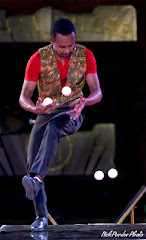
The good news out of one-year-old Circus Bella, based in Oakland, is that some of the best musical scoring you will come across on any lot is on this lot. Moreover, there’s a cool tilt to the company's camaraderie, a playful approach to taking on standard circus skills. For example, Bronkar Lee begins as a drummer, then drums himself into a stirring ball juggling workout.

Show's biggest single asset are are five hard-working musicians. What a refreshing departure from the abysmally electronic norm. Throw away your CDs. Ditch your dreary disco dreams. With a few more acts, some honing and tightening, this perky outfit might find a string of civic sponsorships out there, something like what the Pickle Family Circus did in its day.

The funky band starts out, pre show, jamming it up, Dixieland style, like a group of black musicians in front of an old midway side show. And you might wonder if that's all you're gonna get. Well, no. Once the circus begins, these windjammers surprise, do they ever, riding charts composed and arranged by accordionist Rob Reich, by answering each entree with just the right tempo and tone. What Reich gives us is an ersatz Cirque sound, yet with a generous deference to each act.

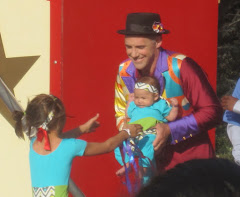
The one hour romp sags in spots. Jan Damm’s suspenders routine takes too long to get snapping. A comedic presence not always well served by the scripting is Jeni Johnson (seen in the two photos above), eccentrically uniformed musical conductor sometimes with baton in hand. She is just plain funny to look at. Her officious air kept me smiling. How does she shtick it to us? Well, for one, she stops the show capriciously to walk over to the ring curb, upon which is parked her big soda cup, there to favor herself with a sip. While we wait. A facetious time out at our expense. It works. Other times she flops out trying to get into the act and has to be carried off. All fun to watch.

But a running band-leading gag (casting Johnson as a conductor getting no cooperation from her musicians) runs on too long like a predictable cliche and doesn’t quite produce. She is an amusing presence I would welcome back.

Invention adds nuance to the generally mid-level routines on display here, giving each a certain wry counterpoint. Nimble contortionist Ember Bria and rola-bola performer Jan Damm deliver the essentials. On the slack rope, David Hunt takes a summer afternoon holiday, making it all look perhaps a little too easy. On a higher level, polished Abigail Munn turns in a skilled single trap routine full of sharp drops and defined positions. Her pro turn only lacks a big swing arc pay off.

To its credit, the program spares us the bed sheets (aka: “fabric”), spares us the hula hoop and the dime-a-dozen motor bike up the inclined wire. Circus Bella, co-directed by Munn and Hunt, avoids the obvious.

Company joins together into a zesty group juggling bash to finish off the party. It makes for a fizzy finale, giving the end frame a celebratory lift.

One last qualm: When did circuses forget how to simply, START? I'd vote for a first burst into the ring free of Scotty the Bunny talking to us. (Scotty's nebulous role throughout the show strikes me as a tad gratuitous.) There is a silent movie feel about this circus that needs to remain silent. Before a responsive crowd on the admission-free grass of Yerba Buena Gardens in San Francisco under cloudy skies, they made a promising mark. Go, little Bella!


6/1/09

Wednesday, May 23, 2012

Happy Old Year! ... Highlights and Lowlights of the Season Past

Out of the past: From December 31, 2011


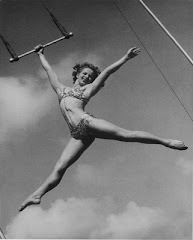
Tomoko Nakagawa, 1955

Let's give a toast
-- and roast a little, too -- to the season about to hit the history books. These informal impressions are drawn from my visits to most of the big tops and to Ringling. They are NOT based upon a careful evaluation of all I've seen.

Randomly speaking ...

Best News: Big Apple Circus is in fine hands, those of new artistic director Guillaume Dufresnoy. He has displayed both a penchant for novelty (porcupine and pig!) and a subtle flair for top-drawer staging. Will this alone turn the corner? Not exactly, but I think BAC has too much going for it to hit the skids. [comments that follow pertain to Dance On!]

Worst News: Continued media-rattling allegations of elephant abuse at Ringling: Mother Jones magazine doing a story on the issue; the show reaching a $270,000 settlement with the USDA, without admitting guilt. Jay Leno making hay of the issue on the Tonight Show. These unwelcome developments, combined with a bill being passed through congress that would curtail performing animals in circuses -- and the mere idea of the Ringling staff being taught how to handle and care for its own animals by USDA outsiders -- may mark the most embarrassing PR setback ever for "The Greatest Show on Earth." Not to mention the negative impact it will have upon public perceptions in general of all circuses. Who is ultimately responsible? Kenneth Feld.

Welcome Return: The aerial ballet, in new diverse forms, as witness wonderful incarnations of it on Cole Bros. Circus of Stars and Ringlings' Fully Charged.

Best act combing acrobatics and comedy: The African tumblers on Circus Vargas. A sly riot.

Most innovative act: The Wuqiao Acrobatic Troupe on Uni-wheels at Big Apple Circus

Best old thrill turn cleverly recycled. The human fuse on Ringling's Fully Charged.

Most delightful animal act: (hope I got this one right): Jenny Vidbel's horse-riding goats.

Best ringmaster (kindly keep in mind, I do not see all shows) Kelly Miller's John Moss III.

Worst ringmaster. Shall we count the blowhards? How about Cole, Ringling (Iverson), Vargas, and Carson & Barnes.

Best band: Big Apple Circus

Best taped score: Cole Bros. Circus of Stars

Worst performance setting (no rings,no respect): a tie between Ringling and Cole Bros. Circus of Stars

Best spectacle: The second half segments of Ringling's Fully Charged

Most Offensive spectacle: Unused ring curbs stacked in clusters on Ringling Fully Charged set. Rub your indifference in our eyes, Feld Family!

Warmest atmosphere: Kelly Miller Circus

Best little house act bordering on the amateur: The modestly delightful dogs on Carson & Barnes.

Most impressive contortion display: the solo contortionist on Carson & Barnes. [I have since learned that he was likely Franklin Solis]. He brings exciting new dynamics to an act that can all too often seem all too sloooooooooooooooooooooooow. Bravo!

Most dazzling young big top star: Adrian Poema, Jr. on Kelly-Miller.

Most hair-raising thriller: As I recall, on Circus Vargas, the separation between the two halves of the Globe of Death when the thing split open was incredibly wide, giving me a chill I rarely get at circuses these safer days.

Most vexingly uneven show: Carson & Barnes, from world class (Solis, among two or three top turns) to world crass.

Most remarkably scored big cage act: Cole Bros. Circus of Stars

Worst prop department: Cole Bros. klutzy forklift operations.

Biggest downer of the year: the thoroughly mean-spirited new film Water for Elephants.

Worst show-disrupting spiel: A tie between Kelly Miller's Peterson Peanut plea and Ted McCray's prolonged snake photo grind on Circus Vargas, bloating the intermission for as long as it takes.

Best performance setting: Big Apple Circus

Biggest disappointment: Cirque du Soleil's Totem. Is the world running out of talent enough to stock the CDS franchise? A thousand dry ice machines, a thousand flashing laser beams will not completely disguise threadbare goods.

Most welcome sight: A full house at Circus Vargas in Hollywood. Me wonders if the terrific CV product placement in Water for Elephants caused a minor stamped onto the lot at Sunset Boulevard -- boffo location!

The last word: To Baraboo's perennial booster, the good Doc Bob Dewel, who, like too many "visitors" to this blog, never deposits a single comment here but charms his way in through my e-mail. Bob's latest report on restoration work underway at his beloved Al Ringling Theatre: "Apparently we are never destined to have a sugar daddy with a million bucks or so, but are slowly restoring on our own, with a qualified artist. Outer lobby gleams, inner lobby is nearly done---we spent $1000 just to verify for certain the original colors (Peach and Gold, light and bright). ... All eleven dressings rooms restored, Ladies lounge partially finished ...Rapp and Rapp would be proud. So would Al. Ringling. Incidentally Al’s magnificent mansion is for sale! "

The last photos: Let's bring on Lory Lagoyda, whose mom and dad worked on Ringling 1955-56. Her mother, Tomoko Nakagawa, came over when she was just 18 with the Uyeno Troupe -- eight young ladies --from Japan, imported by John Ringling North to lend additional beauty and charm to production numbers. Lory's dad worked with the elephants. Here are some pics of Tomoko, and how happy she looks to be in the great Ringling chorus!

Tomoko Nakagawa in the Mexicanorama aerial ballet, 1956

One of the Mama's in the Park, 1955

Say it With Flowers, 1956 spec

And that's a Happy Old Year!

12.31.11

Tuesday, May 22, 2012

Out of the Past: How Quickly Does Today Become Yesterday


That's the only bummer in life, you can't stop the clock. Tick tick tick. Day after day after day.

Already, the year will soon be half over, and, yes it just began -- yesterday.

Like an old railroad circus teasing a new town everyday, onto the lot and while the tents were going up you could almost feel the troupers edging in their minds toward tomorrow's town. You could almost hear a Big Circus Clock ticking away. During the evening show, after each act they'd strike the props and lug 'em out of the tent, and it felt like they were already deserting you in spirit. Packing up down there in the spangled shadows to make a fast exit back to the runs, up onto the flats and down the rails for some other place in a darkening void.

The tented city that moves by night, F. Beverly Kelly called it. A phrase that enchanted my entire boyhood. The tented city that moves by night.

Perhaps not so different from life. Go to bed we do. Dream we might. Wake up the next morning to face another day as the Big Clock keeps ticking away.

Looking back at past posts, I see people no longer with us, shows still struggling but still out there aiming to recapture lost glories. Aiming for the full houses that seem to get harder and harder to talk into tents.

I read reviews I've put out of circuses that are doing better, of circuses that are barely getting by. And the Big Clock keeps ticking. Another season comes. Another season goes.

I read about ring stars fading, ring stars rising. The comments are much less. I stopped letting anybody into the tent. Anonymous is too anonymous for me. Anonymous only enlarges a cold alien world of strangers too afraid of themselves to face each other. Was the circus ever about that? Sometimes, silence is better than a faceless coward. Sorry I said that, but I did.

Tomorrow comes too soon. Tomorrow stays too soon. They add up, one upon each other, like an oppressive pile of dueling memories, challenging us to make feel-good sense of them all. Grateful we should live to be, for "memories," said the late Beverly Dvorett, the wonderful lady from Ohio who followed the stars out to Beverly Hills and years later produced my musical Circus Kings in a small equity-waiver playhouse on Vermont north of Wilshire -- "memories are all we end up with." Such a wise outlook she shared with me one evening in Norm's restaurant on Sunset Boulevard. I often think back upon that moment. Save up as many good memories as you are lucky to collect, was Beverly's philosophy.

Here, starting tomorrow, are some out-of-the-past realities, or so they felt at the time. I'm riding the rails for a spell, following the arrows into a tent or two, to enjoy a little more of tomorrow's yesterdays.

Saturday, May 19, 2012

Johnny Carson, Facebook, and Loneliness

photo from Carson Entertainment

Last night, I watched an excellent new documentary on Johnny Carson's life put out by American Master's on PBS. If there really is a deep mystery about the man (that's how some like to view him), this two-hour program, a crystal clear account of the entertainer's life, should put such idol speculation to rest. He was one very shy, very private person who was a great actor before the cameras. Away from the set, he was a chronic loner obsessed with his television career and with a series of easy affairs offered him by many beautiful women, some of whom he married.

Said Carson once during an interview, explaining why he was so shy and ill-at ease at public gatherings, he simply did not enjoy the same comfortable control of situation as he did when hosting the Tonight Show. That's why.

Carson craved a certain love that he evidently could only get from an audience. He was unable or unwilling to try getting it from either his wives (for every long) or from his three sons by his first marriage, to whom he displayed a cool distant indifference. The culprit seems to have been Carson's very own mother, Ruth, a strange heartless Mommy Dearest character who nastily discouraged her son in his theatrical ambitious, even ridiculed him during his most successful days as king of late night. Carson was born in Iowa and grew up in Nebraska. Yes, that's where Mommy Dearest came from. So much for those lionized mid-west "family values."

During his 14-year retirement away from the spotlights, Carson privately and without fanfare wrote out millions of dollars in checks to charitable causes. How sadly ironic are those mortals like Carson who can give so lavishly to strangers but can't give hardly a shred of affection and support to their own kin. The man may have been just plain selfish. In the end, sharing space with his fourth wife Alexis Maas, he spent most of his time reading books, lobbing tennis balls back and forth, and sitting alone out overlooking the edge of the Pacific Ocean, savoring the waves of Malibu and beyond.

Onto the waves of Facebook, and to the hyperventilating media blitz over its first day on the stock market. Experts called the event a virtual flop. And I am smiling. Having watched and believed the searing film, The Social Network, I view Mark Zuckerberg as an opportunistic scoundrel who stole the idea from some college classmates, and then betrayed a few who considered him friends and helped him on the upswing. Zuckerbeg was something of a loner himself, who couldn't get a date and is now setting out to bring the world closer together in the facebook universe.

With every new electronic gadget (make that "toy" if you wish) that comes down the iPike, the average human being may be turning more insular and isolated, and -- worse still -- not pausing to consider the long term consequences to the spirit. The Facebook phenomena arguably combines personal isolation with the illusion of intimacy, and I wonder if there is a danger in a "virtual reality" that may encourage people to settle for safe easy fantasies of the mind over actual social realities lived out in the flesh. Perhaps this rapidly expanding electronic world will redefine the very essence of human life on the planet.

Back to Johnny Carson. The American Masters profile, masterfully assembled and formed, in the end rendered the man not a mystery at all. And I have no desire to learn anything more about his private life, for I think there isn't much more to learn. I'd much prefer experiencing the king of late night in the manner of, as Norma Desmond puts it in Sunset Boulevard, "all those wonderful people out there in the dark," waiting to see the curtain part and to hear Ed shout, "Heeeeeeeeeeeeeeeeeeeeeere's ............... Johnny!"

Friday, May 18, 2012

Shrine Clowns Bring More Harm Than Laughter to the American Circus

I'm about at my wits end over the mere thought of Shriners in greasepaint pretending to be clowns, provoked to put out this post after being reminded of how unwanted and unwelcome they are by two reviews in the current issue of Circus Report of two different Shrine circuses -- one by Chuck Burnes on Circus Hollywood working for the Tampa Egypt Shrine; the other by Herbert Ueckert of the Osman Shrine offering at St. Paul.

Quipped Burnes, "The Shriners returned with what they thought was a funny safe-cracking routine ... the Coronas show was very good. The Shrine clowns were not."

Observed Ueckert: "The Osman Shrine clowns in a painfully long baseball gag provided an interlude of which nothing more needs to be said as readers probably are aware of this reporter's views on Shrine clowns."

Most of us would wholeheartedly agree. Considering the history of Shrine Circuses in this country, it is a shame that so many temples, by virtue of pulling the strings and using the "producers" more as booking agent whores than producers, continue to subject the public to the slipshod, half-baked programs they themselves produce.

How does Shrine clowning hurt the circus business? Assuming for a moment that by "business," I am referring to "entertainment," let us count some of the ways:

* Audiences are not fooled. Audiences sympathetic to worthy Shrine causes may refrain from expressing discontent, but the embarrassing spectacle of a Shrine "clown alley" may resonate for years in their collective memories.

* Less opportunities for professional clowns -- what's left of them. Feld Entertainment, to its credit, trains many young jesters; then, where next for them? I can't recall in my youth ever going to a Shrine circus that did not include some of the best clowning in the country. The mere thought of a bunch of Shriners giving themselves free reign, coupled with obscenely long concession-revenue-producing intermissions, leaves me with virtually no desire ever to step into a Shrine circus again. And to think, the first truly great circus performances I witnessed were produced by Polack Brothers for Shrine temples from coast to coast.

* Less incentive for younger clowns to stick with it. If an aspiring clown sees fewer circuses actually hiring professional fun makers, what will that do for his/her motivation? Self-esteem? Pride of profession? Imagine how this must affect the ambitiously creative team of Steve Copeland and Ryan Combs at moments when they, as well they will during the course of their careers, contemplate opportunities away from Kelly Miller Circus? Where, indeed, would they go? The tent shows, thankfully, are still open to hiring clowns. Indoors for the Shriners? I cry picturing those guys having to share the rings with a bunch of self-deluded amateurs.

* Deprives the public of a key element in a good circus program: Clowns who make people laugh in clever unexpected ways.

* Denigrates nearly to zero the once-great, once respected "Shrine Circus" name.

What can be done? Bottom line, nothing can be done -- unless and until the producers themselves were to refuse allowing into the programs they allegedly "produce" these clunsy overblown bores.

As Chuck Burnes noted, "But there's nothing anyone can do if they want to keep their contract."

A vicious cycle. Contract kept. Another mucked up mediocre performance the result.

Need any of us wonder why fewer and fewer Shrine temples are even trying to put out a circus anymore? I feel no sympathy whatsoever for their diminishing number, considering the harm they are visiting upon the image of circus art in America.

Cry, clown, cry.

Sunday, May 13, 2012

Sunday Morning Looking Back:The Brilliance of Braathen -- World Premiere of Photographer's Color Slides At ISU Puts Milner on the Map


When I first encountered, or should I say wrestled with, the extravagantly overproduced book, Circus: 1870-1950, at the San Francisco Public Library, I was soon swept away by magnificent color photographs I'd never before seen, mostly of floats, costumes, performers and backyard scenes from the John Ringling North era. Such mesmerizing revelations of a circus reinventing its lure in top-of-the-line design art. I could not stop the turning pages.


Many, more likely most, of the more spectacular visuals (can you see a foreshadowing of Cirque du Soleil, above?), are the work of photographer Sverre O. ("Bex") Braathen, and they give this huge, narratively ineffectual volume a clear aesthetic reason for being. They thrill our circus fantasies, bring glory to the big top, especially to the one operated by Ringling-Barnum during the remarkable years of artistic innovation through the 1940s-1950s. In particular, they offer indisputable evidence of the genius of costume designer Miles White; secondarily, of the captivating midway face lifts created by famed industrial designer Norman Bell Geddes.

From whence these heretofore unseen images? I assumed, giving it no thought, oh, from Sarasota or Baraboo, of course. After all, isn't that where all circus illustrations come from?


No! Not anymore. Now, in breathtaking Braathen brilliance, a new gold mine of circus photography is coming to light from out of a place called Normal -- as in Normal, Illinois, home to Illinois State University. The golden goodies, and they number in the thousands, kids, reside in the Special Collections unit of the Milner Library. Their major contribution to the Taschen tome marks a virtual world premiere for Braathen. Before that, though hard to believe, the Kodachrome slides were only viewed when the photographer himself showed them to friends. (Braathan was an attorney by trade, avid circus fan and writer.) Occasionally, some would show up in Bandwagon. Here, through the outreaching generosity of Library Specialist Mark Schmitt, I am posting a sample of the magic.


Best of all, they are now coming to a computer near you, credit the good will of some fine and sharing folks at Illinois State's Circus and Allied Arts Collection, curated by Steve Gossard. You will be able to access a steadily increasing number of Mr. Braathen's shutter delights as they come on line. Here's your link to the inaugural parade:

http://tempest.lib.ilstu.edu/braathen.php


Go ahead, be dazzled. In the current issue of Bandwagon, Fred D. Pfening III, introducing a story written by Mr. Braathen's wife, Faye O., about their 2-week travels with Ringling-Barnum just before its last days under canvas in 1956, ranks the work of Braathen as "only a notch or so below the acknowledged masters of the field, Fred Glasier, Harry Atwell, and Edward Kelty." I'm not completely sure about the sanctity of those names alone. Looking back at old National Geographic magazine stories on circus that featured color plates, several other names standout that I've never heard of. Even Ringling flakmaster F. Beverly Kelley took some superb images that were published by NG. In later years, Ted Sato, serving a brief three- or four-year stint for Ringling, with a superb eye for composition, produced some stellar black and whites; he has yet, in my opinion, to receive the credit his marvelously composed frames truly deserve. But Pfennig, as I see it, is surely correct in placing Braathen near the top.


For color, clarity and the occasional well-framed shot, Braathen is now gratefully engraved in my brain. In essence, his work lends true star power to the Taschen tome, itself essentially a lavish photo showcase with no clear structure to speak of. Mr. Braathen appears to have been particularly adept at grouping performers together in the backyard. For the most part, his camera stayed out of the tent, owing to lighting restraints. I would love to see any action photos he may have taken, but there is no evidence so far that he flourished in this area.


What bothers me the most, among a number of textual sins committed by Taschen's editor Noel Daniel, is that, of the few photo sources acknowledged on jacket copy or in a brief preface, the name of Sverre O. Braathen, is nowhere to be found. Incredible ingratitude --- worse yet, blundering editorial oversight and/or ignorance --- for a photographer whose work gives this sprawling showcase a distinctive recurring luster. Moreover, it seems a crime that photo captions could not have included a code linking each to its respective source.


In one of his e-mails to me, notes Mr. Schmitt,"1/3 of that Taschen book is sourced from our Sverre O. Braathen collection, but we have enough images still to fill, say, 30 volumes set solely devoted to our collection."

Among the gold in Normal, Schmiit estimates they have 3000 COLOR Braathens of Ringling in the 1940s-1950s, approximately 400 of Cole Bros. And for every color shot, Braathen snapped four or five black and whites. He took "thousands" during the 1930s. This epic gold mine has lay unseen for decades.


This 1942 shot of the side show is so quintessential John Ringling North -- the gaudy yet sharply atypical color schemes deliciously seductive. Even theatre critic Brooks Atkinson that spring reviewed the acclaimed Madison Square Garden premiere and issued a raving salute in a special Sunday New York Times piece. The circus of Ringling North had enjoyed a dream season the year before, greeted by one turn-away crowd after another. It's easy to understand how the public was so drawn to and infatuated with the revamped look of the show, from air conditioning units that barely worked to a performance of rare beauty. "It's the best costumed, best lighted and best presented circus in the big show's history," declared The Billboard.


"We also have Arnold Riegger's negatives," writes Schmidt. "Frank Ball's images,and what seems like an endless well of scrapbooks, and loose photographs, not to mention Charles Clark 1922 RBBB images. Thousands upon thousands."

Move over, Baraboo and Sarasota. Normal, you're on.


All photos used with permission from Illinois State University's Special Collections, Milner Library.

From the top:
Antoinette and Arthur Concello
Pocahontas float from "The Good Old Times" spec, Ringling-Barnum, 1952
Midway and entrance, 1941
Henry Ringling North, 1941
Showgirl in tiger spec number, 1944
Lou Jacobs, 1941
The Cristiani Family of bareback riders, 1941
Ringling flat cars loaded, 1941
Side show makeover, 1942
"Hoop De Doo" finale, 1956
Showgirls in spec, 1954

Below: Faye Braathen, Burt Lancaster, and Sverre Braathen.


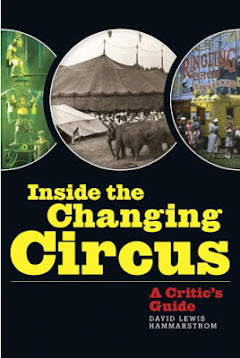
Luckily for me, a few of Braathen's wonderful images appear in my new book, Inside the Changing Circus: A Critic's Guide, though, so as not to falsely tease you, they are in in black and white -- all except for the wonderful image of the Ringling marquee and ticket wagon on a Canadian lot in 1953.

Originally posted 9.10.10

Friday, May 11, 2012

Circus Pinder, Can We Be Friends?

I was surfing YouTube land, as sometimes I do. My friend Dame Dither, currently luxuriating in a summer retreat west of Santa Rosa, sent me a link to an acro-ballet contortion-duo, man and woman offering flawless executions combining equilibristics (WHY does that word never appear in a dictionary???) and erotic posturing. Stress erotic -- sex spelled s-e-x sells, right? This one got steamy hot, which suggests yet another arena for further development among the nouveau set (spell checker won't accept "nouveau" either). The crowd was taken. The crowd was French. Perhaps a competition. Seats packed with the well healed. I watch these lyrical contortions with numbing ambivalence, for they are a little too preciously insular for my taste. In other words, too slow. These are those moments were advanced circus art comes the closest to making authentic inroads into the more abstract world of ballet -- when tautly controlled perfection in a "circus" type setting can feel slightly still born.

At the finish of this video appeared, of course, links to other YouTubes of like kind (it's Friday evening, and what else have I to do?), so, here comes serendipity on demand: I watched one Terry Lemas attempt a triple; she accomplished it, though it appeared as if she and the catcher were locking arms rather than wrists; and upon her return to the fly bar, she missed, into the net. I did admire her stamina.

Then onto another act, the Flying Mendocas, who did lots of things, though most of them fun and flashy and not too memorable, and, from there, finally to one Circus Pinder. Embarrassed to say (fearing the Europeans may disown me), only this much I know about Circus Pinder: I'd heard the name. [blame it, please, on my loyal aversion to flying in airplanes.] Anyway, this 12-minute Circus Pinder sampler caught my attention. Some nice if not spectacular acts yet full of animation and zest. A diablo guy who ended up so joyfully proud of himself, making such an immediate connection with the audience as to give me a true circus high. Two clowns with instruments -- a third stood by with violin at the ready -- made me laugh out loud (high water mark) because of the funny, socially embarrassing sounds related to body functions that their instruments produced when provoked by each other. There were camels and horizontal bars (how I've missed horizontal bar acts). Some Asian kids, all of only a few seconds; they must have been good, I wanted to assume. Suave voice of a ringmaster discretely in the background just right. Music at least added to the infectious spirit of the show. From just these few snippets, it's a circus I would love to see.

That's all.

Thursday, May 10, 2012

Here's a Circus Not Hurting for Money: In Disney's Fantasyland, Big Crowds Are No Problem; Mud, What's That?


At Disney's Magic Kingdom in Orlando, the new Storybook Circus big top goes up in the expanded Fantasyland